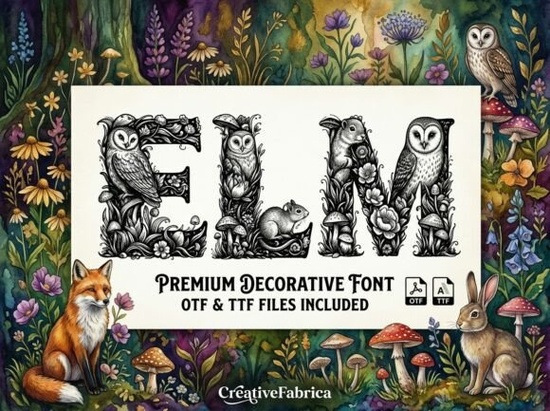
If you're looking for a decorative font that feels like stepping into an illustrated storybook where every letter breathes with woodland life Elm Font is a thoughtful, well-crafted choice. It’s not just a set of letters; it’s a small ecosystem of owls, squirrels, mushrooms, and ivy, all woven into the shapes of uppercase and lowercase characters. Designed with care for readability at medium sizes and charm at larger ones, Elm works especially well for projects where personality and atmosphere matter more than neutrality.
When does Elm Font work best?
Elm shines in contexts where whimsy and nature meet intention. Think of a self-published fantasy novel cover where the title needs to hint at ancient forests not just name them. Or a small-batch candle label for a “moss & amber” scent, where the font quietly reinforces the theme without shouting. It’s also popular among print-on-demand sellers creating nursery wall art, forest-themed greeting cards, or Instagram story headers for eco-conscious brands. Because each glyph includes subtle illustrative detail not cartoonish exaggeration it holds up well in both digital and printed formats when used at appropriate sizes (generally 36pt and up for display use).
How is Elm different from other decorative fonts?
Many decorative fonts lean heavily on ornamentation or trend-driven quirks like exaggerated serifs, distressed textures, or forced hand-drawn imperfections. Elm avoids those shortcuts. Its strength lies in cohesive world-building: the owl’s eye becomes a dot over the “i”, a curled fern forms part of the “g”, and tiny mushrooms nestle into counters of letters like “o” and “e”. That consistency makes it feel intentional, not gimmicky. It’s also designed with practical OpenType features including alternate characters and ligatures so you can fine-tune spacing and expression without switching fonts.
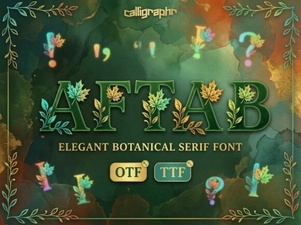
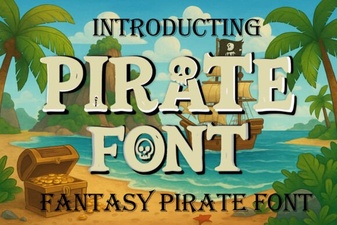
For contrast, Aftab Font offers clean, modern elegance with soft geometric curves great for minimalist branding or wedding stationery. And if you’re working on pirate-themed merch or playful kids’ activity books, Pirate Font brings bold, high-contrast energy with nautical flair. Each serves a distinct mood and Elm stands out for its quiet, immersive storytelling.
What file formats and licenses come with Elm?
You’ll get Elm as OTF and TTF files, compatible with Adobe Creative Cloud apps, Cricut Design Space, Silhouette Studio, and most major design tools. The standard license covers personal and commercial use including selling physical products (like mugs or posters) and digital downloads (like Canva templates) as long as you’re not reselling the font files themselves. There’s no subscription or monthly fee: it’s a one-time purchase with lifetime access and free updates if the designer releases improvements.
One thing to keep in mind: because of its illustrative density, Elm isn’t ideal for body text or small captions. It’s meant to be seen, not scanned. For longer passages, pair it with a simple sans-serif like Montserrat or a gentle serif like Cormorant Garamond both available royalty-free through Google Fonts.
Real examples from creative users
A small business owner in Oregon used Elm for her line of foraged herbal teas, printing it on kraft paper labels with muted earth-tone ink. A children’s book illustrator chose it for chapter headings in a picture book about nocturnal forest animals then layered subtle watercolor textures behind the type to enhance depth. And a craft teacher built a set of printable forest-themed classroom posters using Elm for titles and simpler fonts for instructions, keeping visual hierarchy clear.
If you’d like to see how the characters are constructed, Elm Font includes a full character map PDF showing every glyph, alternates, and stylistic sets. Likewise, Aftab Font and Pirate Font each have their own detailed previews and usage notes on Creative Fabrica.
Before you download
- Check your project size: Elm reads best at 24pt and above avoid using it smaller than 18pt in print or 20px on screen.
- Test spacing: Kerning pairs are included, but always preview headlines at actual size before finalizing.
- Use it for tone-setting not information delivery. Save clarity for supporting text.
- Pair thoughtfully: let Elm breathe by surrounding it with generous whitespace and neutral colors.
- Review the license terms directly on the product page especially if you plan to use it in client work or SaaS templates.
 Explore Aftab Font for Modern Creative Projects
 Designing with Classic Pirate Typography
 Designing with Bisked Font for Modern Projects
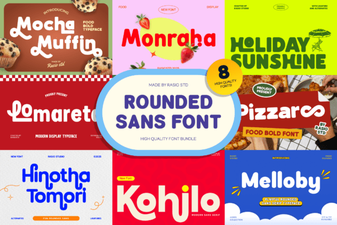 Get Creative with Rounded Sans Font Bundles
 Snapshot Font: Design Templates for Modern Websites
 Designing Fonts for Nuanced Emotional Expression